Explore all our board games! Right here
Explore all our board games! Right here


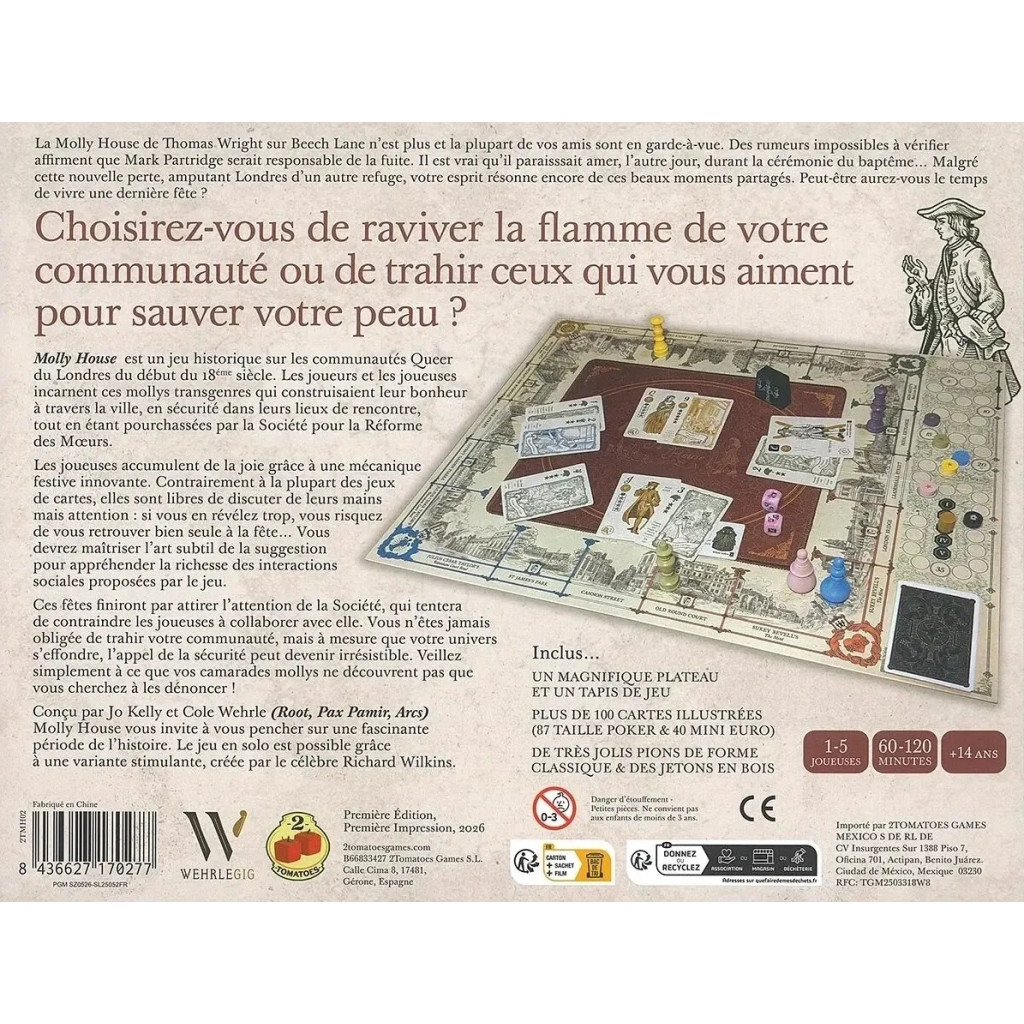




Reference: 2TO.MOL-001-027
Molly House is a historical game set in 18th-century London, centered on the queer community and police raids. Take on different roles, manage risks, and try to achieve your goals.
71,90€
€
€
€

Shipping costs from €1.95 - Free shipping on orders over €60 (metropolitan France)

Your order will be shipped with care

Secure payment

In Molly House, players take on the roles of “mollies”—members of an underground community in 1720s London—who seek to organize parties and gatherings while evading the watchful eye of the Society for the Reform of Morals. The game is based on a hand-management mechanic using “vice” cards—representing desires and actions frowned upon by the society of the time—which players use to trigger festivities and gain reputation.
Its originality lies in its semi-cooperative gameplay: players must collectively accumulate community joy to avoid a collective defeat, while some of them may be forced to become secret informants for the Society, seeking to sabotage the house from within without being exposed. The game draws on extensive historical research to reconstruct this poorly documented community.
Setup involves laying out the board representing London, dealing each player a personal board and a hand of vice cards, and then secretly assigning roles of loyalty or betrayal based on the number of players.
On their turn, a player moves around the board to visit different locations (shops, alleys, cafés), acquire items or additional cards there, and then organize or join a celebration by playing vice cards from their hand. Each celebration generates community joy but also rumors, which can attract the Society’s attention and trigger a raid on the house if they accumulate too much.
The game ends according to one of several scenarios: if the community reaches a sufficient level of joy without being dismantled, the loyal players win a collective victory; if the Society manages to bring down the house thanks to infiltrated informants, the informants win instead of the loyal players; overly severe repression can also lead to a shared defeat for all participants.
The winning side is determined by a combination of the accumulated joy level, the number of arrests, and the identities of the informants—whether exposed or not—at the end of the game.

