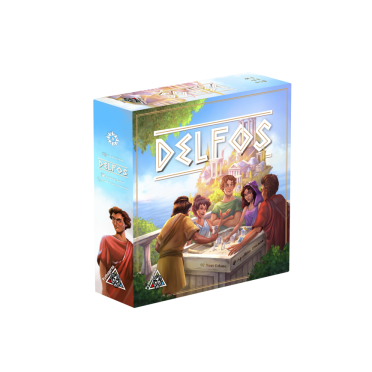
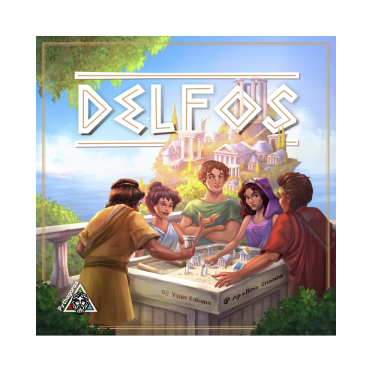
Rebuilding the ancient sanctuary of Delphi: tile-laying and spatial strategy
In Delfos, players take on the role of master architects tasked with rebuilding the ancient Greek city of Delphi, situated on the slopes of Mount Parnassus. Inspired by the history of the Sanctuary of Apollo, the game is based on a combination of grid-based movement and tile-laying mechanics.
Each player collects fragments of ruins to build temples, monuments and public squares. The game’s originality lies in its dual approach to space management: players manoeuvre their architects across a central grid of ruins to extract blocks, then arrange these elements within a shared construction area to shape the city.
This interplay transforms every movement decision into a direct tactical trade-off between the options available on the board.
How to play a game of Delfos
Set-up begins by laying out 60 ruin tiles, divided into five distinct colours, to form the excavation area. Each player receives a Character card associated with a colour, two secret objective tiles and wooden Architect tokens. A shared objectives card is placed in the centre of the playing area.
A player’s turn consists of three sequential actions. Firstly, the architect moves in a straight line across the grid of ruins until reaching a targeted tile. The player then takes possession of this tile to place it in the new city, adhering to the rules of adjacency between monuments of the same type or complementary colours.
Finally, the player confirms their geometric criteria. With smooth turns and an average playing time of 30 minutes, waiting times are kept to a minimum, making the game suitable for both accessible family play and a challenging, strategic contest.
The best architect
The game ends when the supply of ruin tiles is exhausted or when the city layout reaches full capacity. Builders then calculate final victory points. Each architect scores points for every tile matching their character color placed within the rebuilt city.
Majority control of contiguous color zones awards additional points to leading builders. Completed secret objectives and public card requirements add to this overall total. In the advanced mode, asymmetric character powers alter scoring criteria, providing fresh tactical priorities across playthroughs.
The architect who achieves the highest point total wins the game.