Explore all our board games! Right here
Explore all our board games! Right here

Reference: GMT-0501-25
79,95€
€
€
€

Shipping costs from €1.95 - Free shipping on orders over €60 (metropolitan France)

Your order will be shipped with care

Secure payment
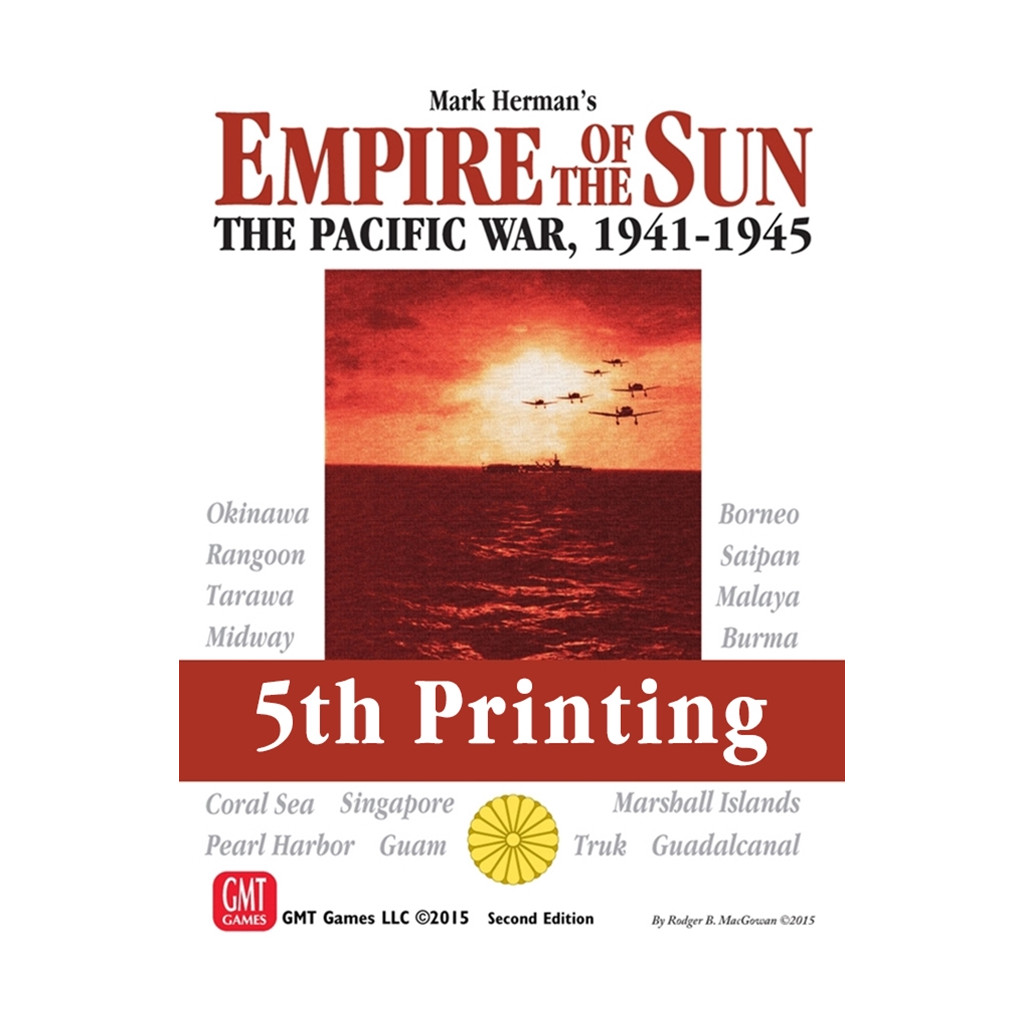
Empire of the Sun: The Pacific War 1941-1945 5th Printing uses a variant of my card-based system. The game features a map covering the Pacific theater of operations, from India to Hawaii and from the Aleutians to Australia. It is the first map-based game to use hexagons, which simplifies the calculation of aircraft movements and ranges. Each game turn covers 4 months (three turns per year), with a special turn in December 1941 (two special cards), for a total of 12 game turns for the campaign.
The game is set at the strategic level and uses naval units organized by warship class (e.g., the CV Wasp, the BB Washington, etc.), air units at the air force, air fleet, or air division level, and most ground units are army corps or armies, although there are a multitude of specialized units at the division level and below. The game features 165 cards divided between an Allied deck and a Japanese deck.
The game uses a two-tier combat system, with air and naval combat preceding ground combat. The system requires players to roll a die to determine combat effectiveness, which is a strength multiplier ranging from 0.5 to 2. This value, multiplied by the unit’s strength, corresponds to the number of damage points inflicted on the enemy in combat, with certain special conditions based on the number of aircraft carriers present and other similar factors.
In terms of gameplay, China is represented abstractly using a track where the triggering of certain events and Chinese offensives put pressure on the Allies to support this theater of operations with resources, lest it fall and damage Allied morale. This is counterbalanced by the fact that Japanese ground reinforcements come from this theater; thus, the more they draw on these resources for conflicts elsewhere, the better China’s chances of survival.
Northern India and Burma are active theaters of operations where most of the game’s ongoing ground war takes place. If the Japanese manage to occupy northern India, they can drive that country and its Commonwealth units out of the war.
Australia can also be eliminated from the war, though it is difficult to keep it out of the conflict permanently.
And then, of course, there are the famous island campaigns, with the United States crossing the Pacific to eliminate Japan from the war.

Empire of the Sun: The Pacific War 1941-1945 5th Printing uses a variant of my card-based system. The game features a map covering the Pacific theater of operations, from India to Hawaii and from the Aleutians to Australia. It is the first map-based game to use hexagons, which simplifies the calculation of aircraft movements and ranges. Each game turn covers 4 months (three turns per year), with a special turn in December 1941 (two special cards), for a total of 12 game turns for the campaign.
The game is set at the strategic level and uses naval units organized by warship class (e.g., the CV Wasp, the BB Washington, etc.), air units at the air force, air fleet, or air division level, and most ground units are army corps or armies, although there are a multitude of specialized units at the division level and below. The game features 165 cards divided between an Allied deck and a Japanese deck.
The game uses a two-tier combat system, with air and naval combat preceding ground combat. The system requires players to roll a die to determine combat effectiveness, which is a strength multiplier ranging from 0.5 to 2. This value, multiplied by the unit’s strength, corresponds to the number of damage points inflicted on the enemy in combat, with certain special conditions based on the number of aircraft carriers present and other similar factors.
In terms of gameplay, China is represented abstractly using a track where the triggering of certain events and Chinese offensives put pressure on the Allies to support this theater of operations with resources, lest it fall and damage Allied morale. This is counterbalanced by the fact that Japanese ground reinforcements come from this theater; thus, the more they draw on these resources for conflicts elsewhere, the better China’s chances of survival.
Northern India and Burma are active theaters of operations where most of the game’s ongoing ground war takes place. If the Japanese manage to occupy northern India, they can drive that country and its Commonwealth units out of the war.
Australia can also be eliminated from the war, though it is difficult to keep it out of the conflict permanently.
And then, of course, there are the famous island campaigns, with the United States crossing the Pacific to eliminate Japan from the war.
