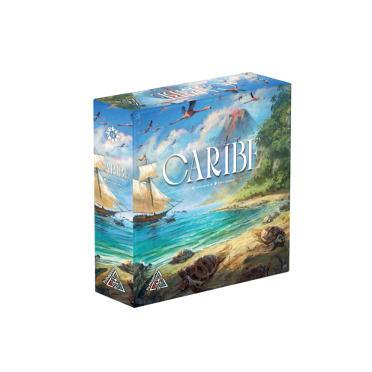
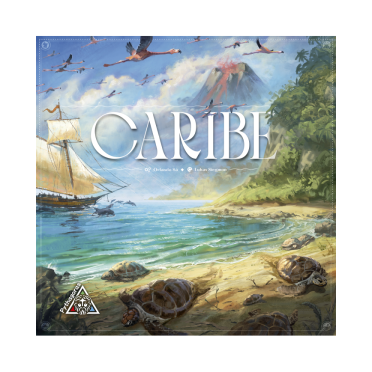
A game of scientific exploration in the Caribbean in the 19th century
Caribe immerses players in the golden age of scientific exploration in the Lesser Antilles, where they take on the role of expedition leaders tasked with documenting the local biodiversity.
The game stands out for its original setting: far removed from the clichés of piracy, it highlights the quest for natural history and the academic rivalry between European universities.
Players explore volcanoes, tropical forests and lagoons to observe rare species such as flamingos, sea turtles and dolphins. The system of multi-purpose cards and a modular board offers high replayability, with each game featuring a unique layout of territories to discover.
Tactics and resource management
The game is structured into 9 rounds, divided into 3 cycles of 3 rounds each. On each turn, players must choose an action space on the board, use Theory cards to target specific areas, and deploy their scientist meeples to collect observations.
Adjacent actions provide bonuses depending on the position of opponents or allied pieces. Players must balance progress on the field with the completion of objectives to accumulate victory points.
Drawing cards at the end of the turn replenishes the hand, adding an element of resource management and risk-taking.
To become the most famous naturalist
The game ends after three rounds, and the player who has accumulated the most theory points through their discoveries wins. Players score points by completing knowledge tracks (fauna, flora, geology) and by achieving end-of-game objectives set by European universities (Coimbra, London, Paris).
The scoring system rewards both the diversity of species discovered and the exploration strategy, with bonuses for players who have explored hard-to-reach areas. The end of the game is triggered automatically after the final cycle, and the player with the highest score wins the title of most renowned naturalist.